EDU-Qs for events/schools
Astronomical research has revealed a staggering 85% of the universe consists of elusive Dark Matter. With support from the Quantum Technologies for Fundamental Physics (QTFP) programme, we have developed a demonstration Paul Trap which forms the basis of a series of free secondary school sessions designed share our passion for our work and to increase participation in STEM subjects beyond GCSE and A Level.
Want us to come and visit you?
We’d love to (if we can!).
Contact Markus Rademacher (m.rademacher@ucl.ac.uk) to invite us.




Orbyts

Orbyts is a UK-wide extracurricular programme aimed at increasing participation in research from underrepresented groups at secondary school and sixth form level. It consists of 8-14 sessions guided by a young researcher (PhD or postdoc) in which students take ownership of their own research project and present their findings to other students at the end-of-project conference. For more information or to sign up your school for the next academic year, please visit their website:
How to detect Dark Matter?
We are professional ghost hunters! But the ghost we are looking for is not your typical poltergeist or ghoul. Oh no, our ghost is far stranger.
This ghost lurks in the shadows of the universe but can be found everywhere.
It doesn’t make a sound or emit any light but holds our universe together. Without it, our galaxy would never have formed.
For this ghost is the mysterious dark matter and makes up over 85% of the mass of the universe.
The truly freaky thing about dark matter is that we currently don’t know the form it takes. From astronomical observations, dark matter could be less than the mass of an electron or ten times the mass of the sun.

If we can’t see it, how do we know it exists?
When we look at the night sky, we see something very peculiar.
In our solar system, as a planet moves away from the sun, the speed of its orbit decreases. That’s why a year on Pluto is longer than on the Earth.
However, when we look at distant galaxies something weird happens. Vera Rubin in the 60s and 70s measured that, as you move away from the center of the galaxy, you don’t slow down but rather your orbital velocity stays relatively constant.
But why? This can be explained by there being mass distributed throughout the galaxy, which is invisible to our telescopes, hence “dark matter”!
And this ghost isn’t just in distant galaxies, it haunts the Earth as well. Dark matter is so weakly interacting that it passes through the Earth every day without us noticing. Spooky!
So how do you detect a ghost? Whilst you can’t look for it directly, you feel its ghostly presence. A flap of the curtains, a ball rolling off the table, a cup slowly floats up into the air and then flies across the room. And this idea is the cornerstone of our research.
But dark matter is pretty weak and can’t push a cup. So, we need to go smaller, lighter, microscopic, even nanoscopic! A glass sphere smaller than the thickness of a human hair.
Even then dark matter still isn’t quite strong enough to push it, so we give it a helping hand. We levitate these spheres and hold them very still using electric fields.
-
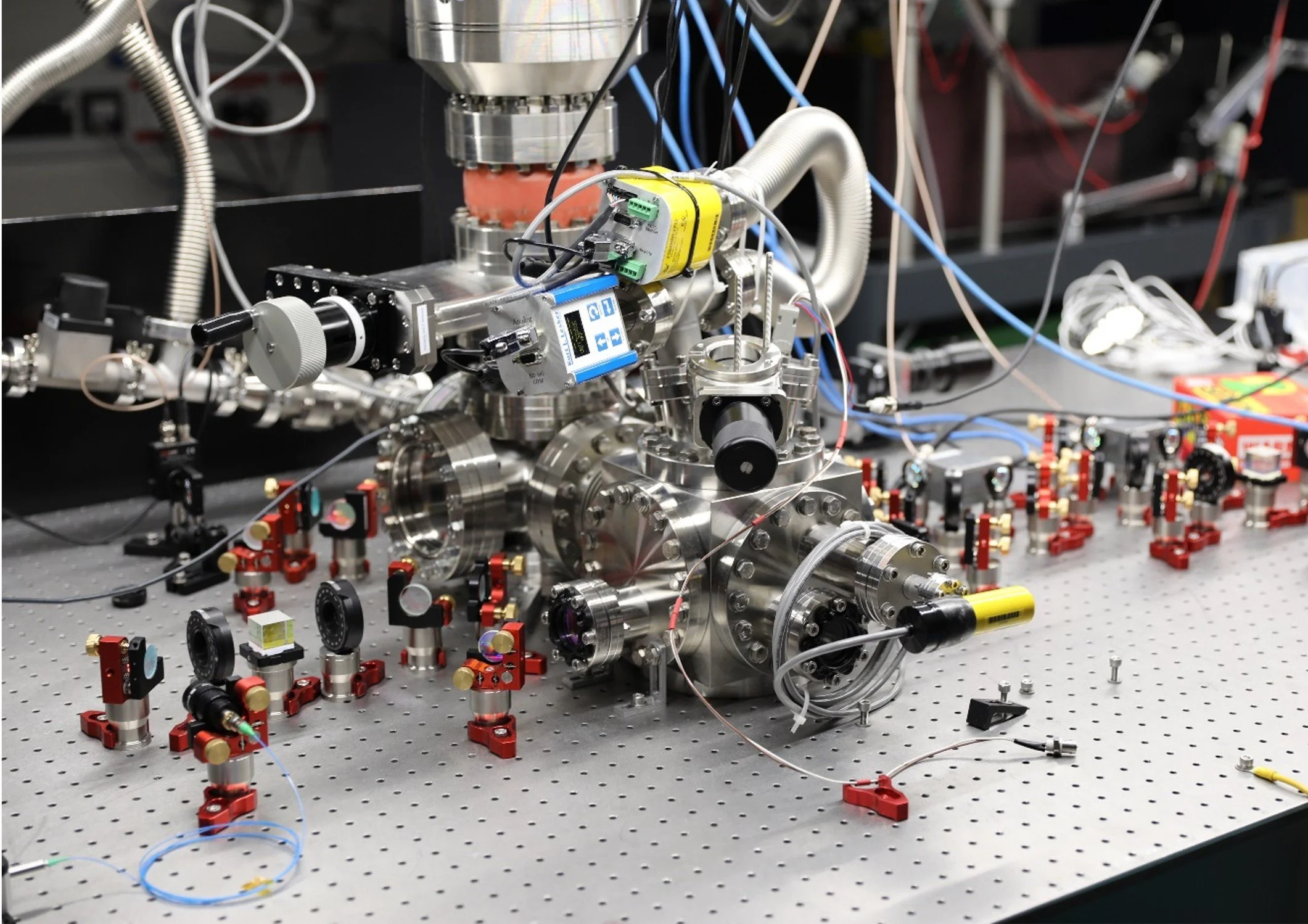
Ideally, you bury your experiment deep inside the ground so that any noise and vibrations are minimised. Unfortunately, the basement of a central London chemistry building was the best we could do. Fun fact: we take our best measurements on Christmas day, when the tubes aren’t running!
The optics and mirrors on the left carefully guide a powerful laser beam into the metal structure in the middle. This is a vacuum chamber which we pump down to less than 1/1000000000 of the pressure of the outside! Inside here is our “optical tweezer”, a very tightly focused region of the laser where the optical force is strong enough to impart force on small objects. The optics and mirrors to the right in the background collect the light and separate it out so that we can monitor the motion of our levitated particle in a very precise way. If our ghost gives it a kick, we’ll know!
Whilst there is a lot of dark matter in the universe, the likelihood of it interacting with our tiny glass sphere is low so we continuously monitor these spheres for months on end. What we are looking for are small changes in the position of the glass spheres.
Like in a game of pool, the dark matter collides with the sphere. The dark matter moves one way and the sphere another. Although we can’t see the dark matter directly, how quickly the sphere moves and the direction it moves in, tells how much energy the dark matter has and what the nature of it is.
These experiments are currently ongoing and one of many in a global effort hunting for dark matter. These microscopic grains of dust might just find our ghost and answer one of the biggest questions in physics.
-
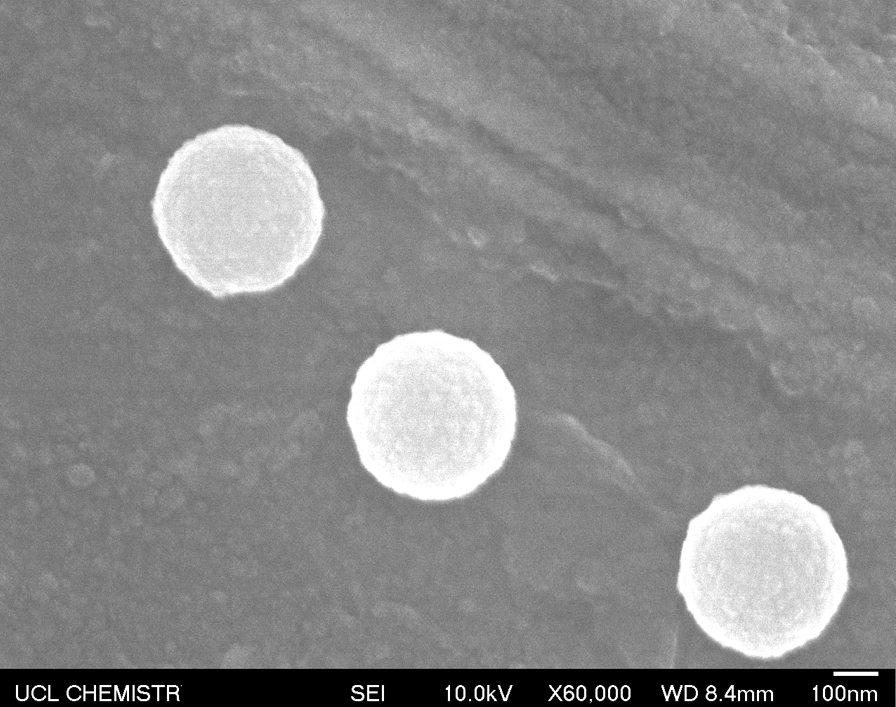
These nanoparticles are so tiny we can no longer use a regular microscope to look at them - we have to fire electrons at them using magnetic “lenses” rather than look through an optical microscope lens with our eyes!

-
We can use electric fields to levitated microparticles if they are charged - just like when you rub a balloon on your head and your hair sticks up!